Ecommerce chatbot challenges are no longer a minor annoyance: they are costing stores sales. In a February 2025 survey of 1,026 US shoppers by Omnisend, 39% said they had abandoned a purchase because of a frustrating chatbot interaction, and only 28% felt AI consistently understands what they need. India shows the same pattern. A Kapture …

Ecommerce chatbot challenges are no longer a minor annoyance: they are costing stores sales. In a February 2025 survey of 1,026 US shoppers by Omnisend, 39% said they had abandoned a purchase because of a frustrating chatbot interaction, and only 28% felt AI consistently understands what they need.
India shows the same pattern. A Kapture CX poll found that 43% of online shoppers named ineffective chatbot help as their biggest frustration, ahead of delivery scheduling and payment problems.
The issue is not that shoppers dislike automation. It is that most deployed bots are rule-based scripts built to deflect tickets, not to help someone decide what to buy. This guide covers the seven most common limitations of traditional chatbots and shows how a modern AI shopping assistant fixes each one.
In this guide: the 7 problems, a side-by-side comparison, what to look for in a solution, and an FAQ.
Problem 1: They match keywords instead of understanding intent
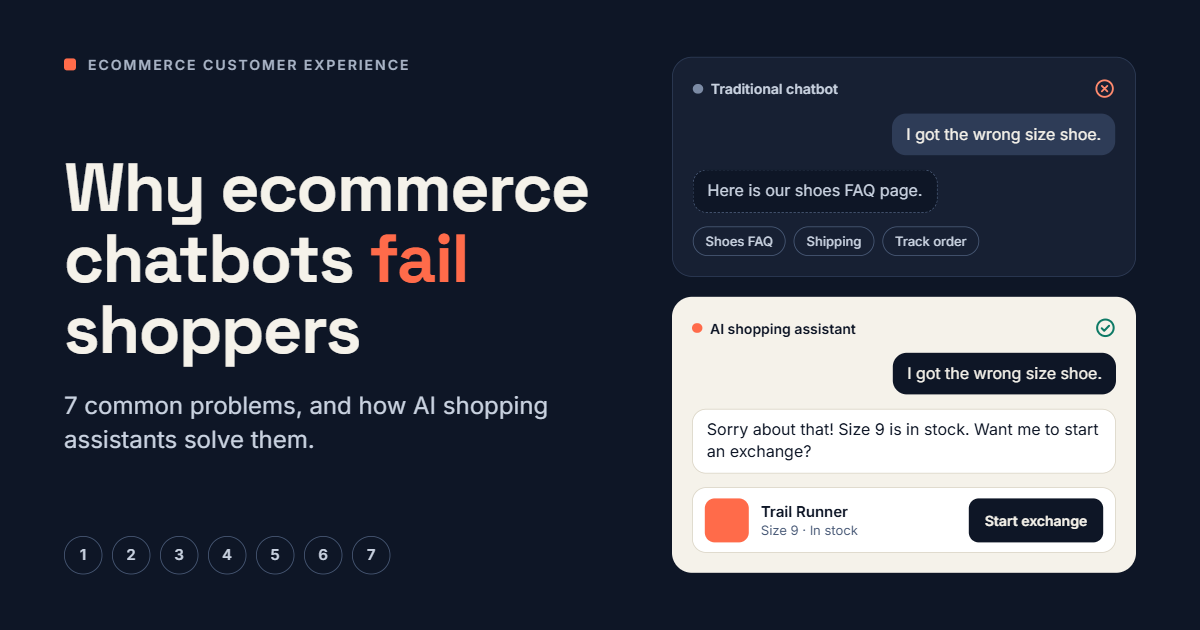
Traditional bots work from decision trees and keyword triggers. If a shopper’s wording does not match a programmed phrase, the bot falls back to a generic answer. A customer who writes “I got the wrong size shoe” may be sent to the general shoes FAQ because the bot only saw the word “shoe”.
How AI shopping assistants solve it: they use large language models to read the meaning behind a message, including typos, slang, mixed languages and half-finished sentences. “Something light for a beach wedding under 3,000 rupees” becomes a real search with occasion, weight and budget, not a failed keyword lookup.
Problem 2: They don’t actually know your catalog
Most legacy chatbots sit beside the store, not inside it. They can answer “What are your return rules?” from a script but cannot say which of your 400 laptops suits a student who edits video. Shoppers who want product advice get a link to the search page instead.
How AI shopping assistants solve it: they are connected to your product feed, attributes, reviews and stock. They can filter, recommend and explain why a product fits, acting like a knowledgeable store assistant rather than an FAQ page.
Problem 3: Every shopper gets the same generic conversation
A scripted bot treats a first-time visitor and a loyal customer identically. It forgets what is in the cart, what was browsed ten minutes ago and what the shopper just said two messages earlier, so people have to repeat themselves.
How AI shopping assistants solve it: they keep conversation context and can use browsing behaviour, cart contents and past orders (where privacy rules allow) to tailor suggestions. This matters because shoppers increasingly expect it: Adobe’s survey of 5,000 US consumers reported that 39% had already used generative AI for online shopping, and among those users 92% said it improved their experience.
Problem 4: Dead ends and clumsy handoffs to humans
The most damaging failure is the loop: the bot misunderstands, offers the same three buttons, and never lets the shopper reach a person. When a handoff does happen, the agent often starts from zero because the transcript does not travel with the customer.
Omnisend’s VP of Customer Experience called a hybrid support model “non-negotiable”, and the Kapture CX poll found shoppers want AI for routine questions and humans for complex ones.
How AI shopping assistants solve it: they detect low confidence, frustration or high-value moments, then escalate with a full summary of the conversation and the products discussed. The shopper explains once, and the human agent picks up where the AI stopped.
Problem 5: They break on complex and comparison questions
Chatbots handle “Where is my order?” well enough. They struggle with “Which of these two phones has the better camera in low light, and does the cheaper one support fast charging?” Questions with several conditions, comparisons or follow-ups are exactly what buyers ask before spending real money.
How AI shopping assistants solve it: they can compare products on the attributes the shopper cares about, answer follow-ups without losing the thread, and explain trade-offs in plain language. One retailer case study on generative shopping assistants reported shoppers who used the AI-assisted experience converting 2.5 times higher than those who did not, although vendor case studies like this should be read as indicative, not guaranteed.
Problem 6: They are cut off from live order and inventory data
A bot that cannot see your order system can only say “Delivery takes 3 to 7 business days.” Shoppers want to know when their order arrives, whether the blue one is in stock in size M, and whether a return has been approved. Order tracking and payment questions are common reasons people contact support, and a bot with no live data sends them to email or a phone queue.
How AI shopping assistants solve it: they connect to the order management system, inventory, shipping partners and return workflows. They can give a real delivery estimate, confirm availability and start a return, so the conversation ends with the problem solved instead of a ticket opened.
Problem 7: Rigid flows are costly to maintain and never improve
Every new product line, promotion or policy change means someone must edit the flow chart by hand. The bot does not learn from the conversations it fails, so the same dead ends keep appearing until a team member notices them in the logs.
How AI shopping assistants solve it: they draw answers from your live catalog, help-centre content and policies, so updates flow through without rebuilding conversation trees. Conversation analytics show which questions go unanswered, which products get asked about most and where shoppers drop off, giving your team data for merchandising and support decisions as well as automation.
Traditional chatbot vs AI shopping assistant
| Area | Traditional chatbot | AI shopping assistant |
|---|---|---|
| Understanding | Keywords and fixed menus | Natural language and intent |
| Product knowledge | FAQ scripts only | Live catalog, attributes, reviews |
| Personalization | Same reply for everyone | Uses context, cart and history |
| Complex questions | Fails or loops | Compares, explains, follows up |
| Order and stock data | Generic policy answers | Real-time order and inventory |
| Human handoff | Late, no context | Early, with a conversation summary |
| Maintenance | Manual flow editing | Learns from catalog and content updates |
| Business value | Ticket deflection | Discovery, conversion and insight |
What to look for in an AI shopping assistant
Not every product that uses the word “AI” fixes these problems. Before you choose, check five things:
- Catalog connection: does it read your real product data, or only a help-centre FAQ?
- Live data access: can it check orders, stock and delivery status?
- Human handoff: does it escalate early and pass along the full conversation?
- Accuracy controls: can you set guardrails, so it never invents prices, stock or policies?
- Reporting and privacy: does it show resolution rate, escalation rate and conversion impact, and handle customer data in line with your privacy obligations?
Start with one use case, such as product recommendations or order tracking. Measure resolution rate, escalation rate, add-to-cart rate and cart abandonment, then expand.
Conclusion
Traditional ecommerce chatbots fail because they were designed to answer a short list of known questions, while shoppers arrive with open-ended, specific and emotional ones. Keyword matching, no catalog knowledge, no personalization, dead-end loops, weak handoffs, no live data and constant manual upkeep all add up to abandoned carts and lost trust.
AI shopping assistants address each of these gaps by understanding intent, knowing the catalog, remembering context and connecting to live systems, while keeping humans in the loop for the moments that need them. For any store that depends on online conversion, the question is no longer whether to move beyond scripted bots, but how carefully to roll out the replacement.
Next step: review your last 100 chatbot conversations, mark how many ended without a resolution, and use that number as the baseline for any AI shopping assistant you test.
FAQ
What are the biggest ecommerce chatbot challenges? The most common are poor intent understanding, generic answers, no personalization, dead-end conversations without human handoff, and no connection to live order or inventory data.
Why do shoppers abandon purchases after using a chatbot? Usually because the bot could not answer a specific question or kept looping. In Omnisend’s survey, 39% of shoppers said a frustrating chatbot interaction made them abandon a purchase.
What is the difference between a chatbot and an AI shopping assistant? A traditional chatbot follows scripts and keywords. An AI shopping assistant uses language models connected to your catalog and store systems to understand requests, recommend products and resolve issues.
Does an AI shopping assistant replace human support? No. The best setups handle routine and discovery questions automatically and pass complex or sensitive cases to people, with the full conversation attached.